
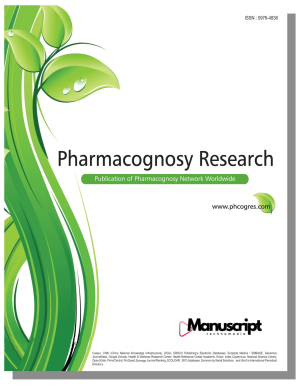
Pharmacognosy Research
Volume 17, Issue 4
2025 · pp. 1077–1398 · 37 articles
- Volume
- 17
- Issue
- 4
- Year
- 2025
- Published
- 2025
- Pages
- 1077–1398
- Articles
- 37
- Sections
- 4
- ISSN
- 0974-8490
- Journal
- PR
In this issue
21–37 of 37Original Article(continued)
Original ArticlePublished: 3 Oct 2025
Prabhakar Basappa Hegade, Praveen Nagappa Bhirdi, Ajit Lingayat
pp. 1274-1280 · DOI: 10.5530/pres.20252331Vol. 17, Issue 4 (2025)Background: The state of excessive bodily fat buildup is known as obesity (Sthoulya). Anti-obesity drugs in the market might cause adverse effects, for safer and more effective anti-obesity medications from plant-based s…
Original ArticlePublished: 3 Oct 2025
Thamizh Sendhamaraikannan, Nithish kumar Arivukkarasu, Ezhil Sakthivel, Abinaya Seevagavazhuthi, Venkatesan Natarajan, Pradeepraj Devarasu, Aravinth Velmurugan
pp. 1281-1292 · DOI: 10.5530/pres.20252332Vol. 17, Issue 4 (2025)Background: Heterocyclic compounds, particularly triazines, have significant attention in pharmaceutical and industrial research due to their broad spectrum of biological activities. Objective: This study focuses on the …
Original ArticlePublished: 3 Oct 2025
Pavithran Janagarathinam, Arvina Rajasekar
pp. 1293-1297 · DOI: 10.5530/pres.20252345Vol. 17, Issue 4 (2025)Background: Despite melatonin’s established pharmacologic profile as an anxiolytic and antioxidant agent, its perioperative use in implant dentistry remains underexplored. As patient anxiety and hemodynamic fluctuations …
Original ArticlePublished: 3 Oct 2025
Kinjal P. Patel, Rajesh A. Maheshwari, Nilay Solanki, Jagdish Kakadiya
pp. 1298-1302 · DOI: 10.5530/pres.20252369Vol. 17, Issue 4 (2025)Background: Syndrome X (Metabolic syndrome), commonly associated with high-fructose dietary intake, is characterized by insulin resistance, hyperglycemia, and related neurobehavioral impairments. Passiflora edulis Extrac…
Original ArticlePublished: 3 Oct 2025
Bhuvaneswari Manoharan, Chitra Vadivu Chinnasamy, Balakrishnan Veluchamy, Raja Kannan
pp. 1303-1307 · DOI: 10.5530/pres.20252315Vol. 17, Issue 4 (2025)Background: The Ceropegia juncea Roxb. Belongs to the subfamily Asclepiadoideae and the family Apocynaceae. The histochemistry is used to localize primary and secondary metabolites within the cells, which can be determin…
Original ArticlePublished: 3 Oct 2025
Adavesh Holeyache, Vishal Chaudhary
pp. 1308-1314 · DOI: 10.5530/pres.20252328Vol. 17, Issue 4 (2025)Background: Phytochemicals from medicinal plants significantly impact healthcare. Piperine, a bioactive compound in Piper longum, exhibits diverse pharmacological effects, including analgesic, antipyretic, antioxidant, i…
Original ArticlePublished: 3 Oct 2025
Arijit Chaudhuri, Biswajit Dash, Ashish Sarkar, Afrin Alam, Ayush Garg, Shivani Devi, Ankita Sharma, Varsha Chauhan, Tanbeer Kaur, Yashna Bawa
pp. 1315-1327 · DOI: 10.5530/pres.20252314Vol. 17, Issue 4 (2025)Background: A medicinal herb called Achyranthes aspera has been used for centuries to treat a wide range of illnesses. By assessing its antineoplastic, anti-microbial and antioxidant properties. This study sought to thor…
Original ArticlePublished: 3 Oct 2025
Nishi Shukla, Shazia Usmani, Sahabjada Siddiqui, Shadma Wahab, Rumana Ahmad, Shabana Khatoon, Sana Parveen, Arti Prajapati
pp. 1328-1334 · DOI: 10.5530/pres.20250003Vol. 17, Issue 4 (2025)Background: The research investigated the mechanism behind the antiproliferative activity of Capparis decidua (Family: Capparaceae). Despite being tested for other cell lines, its mechanism of action is still not well es…
Original ArticlePublished: 3 Oct 2025
Vidya Avadhanam Sudhakar, Chandrakanth Shivappa Karigar, Nandhini Keshava Reddy, Chandana Narayana Swamy, Pattada Vitha Ramesh, Bhavya Janardhan, Sunil Shivaji More
pp. 1335-1340 · DOI: 10.5530/pres.20250019Vol. 17, Issue 4 (2025)Background: Cellulases are the second most popular industrial enzyme because of their many uses, especially in turning cellulosic biomass into sugars for further processing. Objectives: The current study focused on the i…
Original ArticlePublished: 3 Oct 2025
Anoop Kumar, Abilasha Ramasubramanian, Priyadharshini Muthumanickam, Bargavi Purushothaman
pp. 1341-1347 · DOI: 10.5530/pres.20250024Vol. 17, Issue 4 (2025)Tephrosia maxima and Tephrosia callophylla, two lesser-studied members of the Fabaceae family, were evaluated for their phytochemical, pharmacological, and toxicological profiles in this study. Aqueous extracts from shad…
Original ArticlePublished: 3 Oct 2025
Essimanam Rosalie Awesso, Kathrin Arndts, Gnatoulma Katawa, Fekandine Victoire Douti, Fagdéba David Bara, Simplice Damintoti Karou, Achim Hoerauf, Manuel Ritter
pp. 1348-1361 · DOI: 10.5530/pres.20250030Vol. 17, Issue 4 (2025)Background: We previously demonstrated that crude Hydro-Ethanolic Extracts (HEE) of Aframomum melegueta (AM) and Xylopia aethiopica (XA) exhibited anti-helminthic and anti-inflammatory properties with low toxicity. Objec…
Original ArticlePublished: 3 Oct 2025
Manju Madhavan, Gayathri Haridas, Anu C Benny, Dalie Dominic A
pp. 1362-1366 · DOI: 10.5530/pres.20250027Vol. 17, Issue 4 (2025)Background: Vateria indica L. is an extremely endangered tree belonging to Family Dipterocarpaceae. In almost all Unani, Ayurveda, and Siddha medicines, the resin obtained from this tree is used to treat various diseases…
Original ArticlePublished: 3 Oct 2025
Karuna Modi, Rachna Varsani, Mihir Bhatt, Krupa Gadhvi, Mamta Shah
pp. 1367-1373 · DOI: 10.5530/pres.20252305Vol. 17, Issue 4 (2025)Background: Stachytarpheta indica (Family: Verbenaceae), is a tropical plant useful to treat respiratory disorders, dropsy, rheumatic inflammation, intestinal worms and diarrhea. Pharmacological studies indicate antimicr…
Original ArticlePublished: 3 Oct 2025
Archana Shantaram Gadakh, Abhijeet Dattatray Kulkarni
pp. 1374-1381 · DOI: 10.5530/pres.20252311Vol. 17, Issue 4 (2025)Background: Flavonoids, alkaloids, tannins, saponins, and phenolic substances are among the several secondary metabolites that have been identified by phytochemical analysis of Nelumbo nucifera. The hepatoprotective, ant…
Original ArticlePublished: 3 Oct 2025
Neeraj Kumar, Akanksha A, Rama Tyagi, Shubham Singh, Mohd Aqil, Abul Kalam Najmi, Mohd Vaseem Ismail, Mohd. Mujeeb
pp. 1382-1394 · DOI: 10.5530/pres.20252320Vol. 17, Issue 4 (2025)Introduction: Tinospora cordifolia root (T. cordifolia) is a well-known Ayurvedic herb with immune-boosting, anti-inflammatory, and antioxidant properties. It contains Jatrorrhizine (JZ), a bioactive alkaloid with antimi…
Short Communication
Short CommunicationPublished: 3 Oct 2025
Mueen Ahmed KK Ahmed, Chaman Sab
pp. 1395-1397 · DOI: 10.5530/pres.20250002Vol. 17, Issue 4 (2025)Cancer continues to be one of the leading global health challenges, driving increasing scientific interest in natural and plant-derived therapeutic alternatives. This study presents a scientometric analysis of global res…
Corrigendum
CorrigendumPublished: 3 Oct 2025
Halkare Suryanarayana Vasavi, Ananthapadmanabha Bhagwath Arun, Punchappady Devasya Rekha
pp. 1398-1398 · DOI: 10.4103/0974-8490.147220Vol. 17, Issue 4 (2025)The corrections presented in this corrigendum do not alter the results or conclusions of the original article. Read More...