
Original Article · Volume 19, Issue 2 (2027) · pp. 719–725
In vitro Anti-Arthritic and Anti-Inflammatory Activity of Siddha Formulation Pirandai Uppu
Subhashree Hari1, Kanimozhi Selvakumaran2, Murugan Pitchai3
- 1Department of Siddha, Sri Sairam Siddha Medical College and Research Centre, Chennai, Tamil Nadu, INDIA.
- 2Department of Anatomy, Sri Muthukumaran Medical College Hospital and Research Institute, Chennai, Tamil Nadu, INDIA.
- 3Department of Medicinal Botany, Sri Sairam Siddha Medical College and Research Centre, Chennai, Tamil Nadu, INDIA.
Abstract
Background: Siddha medicine uses unique herbal salts like Pirandai Uppu, derived from Cissus quadrangularis, for inflammatory conditions. As a concentrated form, it is expected to be richer in bioactive constituents than the raw plant.
Objectives: To establish the potential of Pirandai Uppu as an anti-arthritic and anti-inflammatory drug through in vitro studies.
Materials and Methods: Anti-inflammatory activity was assessed using the HRBC membrane stabilization method. Anti-arthritic activity was evaluated via the inhibition of egg albumin and bovine serum albumin denaturation methods.
Results: Pirandai Uppu showed concentration-dependent activity in all assays. In the HRBC method, hemolysis decreased as concentration increased. In protein denaturation assays (Egg and Bovine serum albumin), the percentage of inhibition increased with higher concentrations of the formulation.
Conclusion: Pirandai Uppu possesses significant anti-inflammatory and anti-arthritic activity comparable to the standard drug Diclofenac sodium, making it a promising candidate for clinical trials.
Keywords: Anti-arthritic; Anti-inflammatory; Cissus quadrangularis; Pirandai Uppu; Protein denaturation; Siddha
FULL TEXT
INTRODUCTION
Siddha system of medicine is one of the most ancient systems of medicine and possesses several polyherbal, herbomineral and metallomineral preparations. Herbal formulations are generally safe and highly effective. Medicinal herbs are rich in bioactive constituents which attributes to its pharmacological properties. Herbal salts is a unique concept of Siddha system of medicine which involves the process of acquiring concentrated herbal salts rich in active principles from the medicinal herb. Thus, the medicine in the form of herbal salt delivers the desired pharmacological action in the best manner. Pirandai Uppu is one such herbal salt derived from Cissus quadrangularis which can be used for the treatment of conditions involving inflammatory mechanisms. Cissus quadrangularis is a perennial climber belonging to the family Vitaceae (Hamid & Patil, 2023). It is rich in various chemical constituents including triterpenoids like friedelin, flavonoids like quercetin, phytosterols like β- sitosterol, Vitamin C and Calcium. Further, the stem of Cissus quadrangularis is found to contain tannins, phenols, carotene, calcium and phosphorus (Sundaran et al., 2020). Pharmacological studies have revealed that it has anti-inflammatory, anticonvulsant, antimicrobial, anticancer, analgesic and anti-osteoporotic activity (Bafna et al., 2021). Animal studies also indicate that it reduces osteoclastic activity and facilitates bone formation. This property could be due to the phytogenic steroids present in it (Potu et al., 2009). Results of in vitro studies have proved that Cissus quadrangularis exhibits potent anti-inflammatory and anti-arthritic activity (Gopinathan et al., 2015).
Pirandai Uppu which is the concentrated form of the plant will be rich in bioactive constituents and pharmacological properties than the plant itself. It could serve as a promising anti-arthritic and anti-inflammatory drug and also it has been mentioned in Siddha Literature that Pirandai Uppu can be used to treat hemorrhoids, dysmenorrhea, stomach ache, dysentery and skin diseases (Innasimuthu, 2016). These ailments are all associated with inflammatory mechanisms. Generally Non-Steroidal Anti-Inflammatory Drugs (NSAIDs) are used to treat inflammatory and arthritic conditions. However, they cause several adverse effects such as gastric ulcer, renal dysfunction, myocardial infarction, thromboembolism and thrombocytopenia (Ghlichloo & Gerriets, 2023). Pirandai Uppu is safe when taken in the prescribed manner.
Inflammation is defined as the biological response of the body to harmful stimuli, which include pathogens, radiation or toxic compounds. It is a defence mechanism mediated by the immune system (Chen et al., 2017). Lysosomal enzymes released during inflammation play a key role in the initiation and maintenance of inflammatory reactions (Brade, 1980). This results in tissue injury and damage. Lysosomal enzymes can be inhibited by stabilizing the lysosomal membrane. Generally, the ability of a substance to act as an anti-inflammatory drug is tested and determined based on its capacity to stabilize the lysosomal membrane, thus inhibiting the lysosomal enzymes (Smith et al., 1976). As the Human Red Blood Cell (HRBC) membrane is similar to the lysosomal membrane, the stabilization of the erythrocyte membrane is taken as a method for estimating the anti-inflammatory activity of a drug (Saleem et al., 2011). Denaturation of protein is the process that involves the loss of the secondary and tertiary structure of the protein as a result of stress due to heat or any chemical compound (Leelaprakash & Mohan, 2011). It is often related to inflammatory response and results in inflammatory conditions like arthritis (Osman et al., 2016). Inhibition of protein denaturation by a potential drug indicates that it has promising anti-arthritic activity. This can be proved by the in vitro egg albumin denaturation assay and bovine serum albumin denaturation assay.
MATERIALS AND METHODS
Anti-inflammatory study by HRBC membrane stabilization method
Blood sample of 1 mL is freshly collected after obtaining informed consent and mixed with an equal amount of Alsever solution. Alsever solution is added to prevent coagulation of blood and is composed of 2% dextrose, 0.8% Sodium citrate, 0.5% Citric acid and 0.42% Sodium chloride. Sample is then centrifuged at 3,000 rpm for 5 min. Supernatant was discarded and the lower layer containing RBC is collected. 0.85% NaCl (isosaline) is used to wash the RBC’s and centrifuged at 3000 rpm for 5 min. 1 mL of RBC’s is collected, and 9 mL of isosaline solution is added. The solution obtained is HRBC (Human Red Blood Cell). Varying concentrations of the sample is taken in test tubes and by using distilled water it is made up to 1 mL. 1 mL of phosphate buffer, 2 mL of hyposaline (0.36% NaCl) and 0.5 mL of HRBC suspension was added to each tube. The test tubes were then incubated at 37 °C for 30 min and are centrifuged at 3,000 rpm for 20 min. Supernatant was collected, and its absorbance was read at 560 nm. Diclofenac (1 mg/mL) was used as standard and a control was prepared without sample. The percentage (%) of HRBC stabilization was calculated using the following formula:
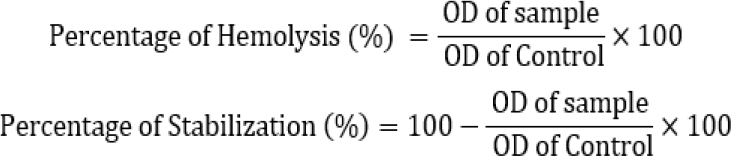
Anti-arthritic study by Egg albumin denaturation method
Different concentration of samples was taken in all the test tubes and made up to 1 mL using phosphate buffer saline (pH 6.4). 4 mL of egg albumin was added to all the tubes including control tube. Then the test tubes were incubated at 37°C for 15 min and further heated at 72°C for 5 min. After incubation, samples and control were allowed to cool for 10 min. Following this, centrifugation at 3,000 rpm for 20 min was performed, and the clear supernatant is collected. The absorbance of the supernatant was measured at 660 nm. Diclofenac (1 mg/mL) was used as a standard, and a control was prepared without sample. The percentage inhibition of protein denaturation (%) was calculated using the following formula:

Anti-arthritic study by Bovine serum albumin denaturation method
Different concentration of samples was taken in all the test tubes and made upto1 mL using phosphate buffer saline (pH 6.4). 0.5 mL of 5% aqueous solution of Bovine albumin fraction is added. The pH (6.3) of the solution was adjusted using 0.1N HCl and mixed well. The test tubes are then incubated at 37°C for 20 min and then heated at 57°C for 3 min. After incubation samples and control were allowed to cool for 10 min, followed by centrifugation at 3,000 rpm for 20 min. The clear supernatant was collected. The absorbance was measured at 660 nm. Diclofenac (1 mg/mL) was used as standard and control was prepared without sample. The percentage inhibition of albumin denaturation (%) was calculated by using the following formula (Dragan et al., 2015):

Statistical analysis
The statistical significance of the results obtained was analysed by 1-way ANOVA. Pearson product-moment correlation was used to determine the relationship in the activities between various concentrations of Pirandai Uppu and pharmacological responses.
RESULTS
Anti-inflammatory study by HRBC membrane stabilization method
The results of the anti-inflammatory activity determined by human red blood cell membrane stabilization method is shown in Figures 1 and 2. The percentage of stabilization of Pirandai Uppu is found to increase with the increasing concentrations of the sample. The percentage of hemolysis is decreasing with the increasing concentrations of the sample, thus indicating that Pirandai Uppu has concentration-dependent potent anti-inflammatory activity. The highest and lowest percentage values of stabilization were observed at concentrations of 2000 µg/mL and 100 µg/mL, respectively. The results are tabulated in Table 1.
| Concentration (µg/mL) | Hemolysis of Pirandai Uppu (%) | Hemolysis of Diclofenac sodium (%) | Stabilization of Pirandai Uppu (%) | Stabilization of Diclofenac sodium (%) |
|---|---|---|---|---|
| 100 | 71.4 | 60.2 | 28.6 | 39.8 |
| 200 | 64.8 | 55.9 | 35.2 | 44.1 |
| 300 | 52.49 | 41.3 | 47.51 | 58.7 |
| 400 | 42.68 | 31.5 | 57.32 | 68.5 |
| 500 | 31.86 | 19.7 | 68.14 | 80.3 |
| 1000 | 28.44 | 9.82 | 71.56 | 90.18 |
| 2000 | 21.2 | 2.46 | 78.8 | 97.54 |
There is a statistically significant difference in the percentage of protection among the various concentrations of Pirandai Uppu in the anti-inflammatory assay, as determined by 1-way ANOVA with p=0.03773, as shown in Table 2. Since the p-value <0.05, the null hypothesis has been rejected. Results of the Pearson correlation analysis indicated a significant large positive relationship between the various concentrations of Pirandai Uppu and HRBC membrane stabilization activity, (r(5)=0.81,p=0.027), as shown in Table 3.
| Source | Df | Sum of square | Mean Square | F Statistic | p-value |
|---|---|---|---|---|---|
| Groups (between groups) | 1 | 1208264.259 | 1208264.259 | 5.4522 | 0.03773 |
| Error (within groups) | 12 | 2659306.028 | 221608.8356 | ||
| Total | 13 | 3867570.287 | 297505.4067 |
| Parameter | Value |
|---|---|
| Pearson correlation coefficient (r) | 0.8104 |
| r² | 0.6568 |
| p-value | 0.02706 |
| Covariance | 10240.2857 |
| Sample size (n) | 7 |
| Statistic | 3.0932 |
Anti-arthritic study by Egg albumin denaturation method
Anti-arthritic activity of Pirandai Uppu is evaluated against denaturation of egg albumin method. The percentage of inhibition increased with the increasing concentrations of the sample indicating the increase in anti-arthritic activity as shown in Figure 3. The lowest value (9.09%) was observed at a concentration of 50 µg/mL, while the highest value (74.2%) was observed at a concentration of 500 µg/mL. The results are tabulated in Table 4.
| Sample Concentration (µg) | Inhibition by Pirandai Uppu (%) | Inhibition by Diclofenac sodium (%) |
|---|---|---|
| 50 | 9.09 | 22.5 |
| 75 | 19.31 | 30.2 |
| 100 | 34.09 | 38.4 |
| 200 | 53.4 | 55.8 |
| 300 | 57.2 | 61.5 |
| 400 | 63.54 | 69.2 |
| 500 | 74.2 | 84.6 |
There is a statistically significant difference in the percentage of inhibition among the various concentrations of Pirandai Uppu in the anti-arthritic assay, as determined by 1-way ANOVA with p=0.01508, as shown in Table 5. Since p-value <0.05, the null hypothesis has been rejected. Results of the Pearson correlation analysis indicated a significant large positive relationship between various concentrations of Pirandai Uppu and inhibitory effect on egg albumin denaturation, (r(5) =0.937,p=0.002), as shown in Table 6.
| Source | Df | Sum of Square | Mean Square | F Statistic | p-value |
|---|---|---|---|---|---|
| Groups (between groups) | 1 | 123360.1986 | 123360.1986 | 8.0289 | 0.01508 |
| Error (within groups) | 12 | 184374.6759 | 15364.5563 | ||
| Total | 13 | 307734.8746 | 23671.9134 |
| Parameter | Value |
|---|---|
| Pearson correlation coefficient (r) | 0.9368 |
| r² | 0.8776 |
| p-value | 0.001863 |
| Covariance | 3918.4643 |
| Sample size (n) | 7 |
| Statistic | 5.988 |
Anti-arthritic study by Bovine serum albumin denaturation method
Anti-arthritic activity of Pirandai Uppu is evaluated against denaturation of bovine serum albumin method. The percentage of inhibition increased with the increasing concentrations of the sample indicating the increase in anti-arthritic activity as shown in Figure 4. The lowest value (6.57%) was observed at a concentration of 50 µg/mL, while the highest value (82.1%) was observed at the concentration of 500 µg/mL. The results are tabulated in Table 7.
| Sample Concentration (µg) | Inhibition by Pirandai Uppu (%) | Inhibition by Diclofenac sodium (%) |
|---|---|---|
| 50 | 6.57 | 12.14 |
| 75 | 17.10 | 19.23 |
| 100 | 27.63 | 30.5 |
| 200 | 46.05 | 49.5 |
| 300 | 51.23 | 62.5 |
| 400 | 75.47 | 79.5 |
| 500 | 82.1 | 89.5 |
There is a statistically significant difference in the percentage of inhibition among the various concentrations of Pirandai Uppu in the anti-arthritic assay, as determined by 1-way ANOVA with p=0.0151, as shown in Table 8. Since p-value <0.05, the null hypothesis has been rejected. Results of the Pearson correlation analysis indicated a significant large positive relationship between various concentrations of Pirandai Uppu and inhibitory effect on bovine serum albumin denaturation, (r(5)=0.979,p<0.001), as shown in Table 9.
| Source | Df | Sum of Square | Mean Square | F Statistic | p-value |
|---|---|---|---|---|---|
| Groups (between groups) | 1 | 124240.3804 | 124240.3804 | 8.0249 | 0.0151 |
| Error (within groups) | 12 | 185783.4054 | 15481.9505 | ||
| Total | 13 | 310023.7858 | 23847.9835 |
| Parameter | Value |
|---|---|
| Pearson correlation coefficient (r) | 0.9791 |
| r² | 0.9586 |
| p-value | 0.0001205 |
| Covariance | 4853.4107 |
| Sample size (n) | 7 |
| Statistic | 10.7538 |
DISCUSSION
Hence, it is proven that Pirandai Uppu has potent anti-inflammatory and anti-arthritic activities. It possesses significant activity comparable with that of the standard Diclofenac sodium. Inflammation is one of the defense mechanisms of the body. Extracellular release of the lysosomal constituents is responsible for the inflammation and damage caused in tissues. Stabilizing lysosomal membrane is crucial in mediating anti-inflammatory response (Azeem et al., 2010). Hence HRBC method was selected as erythrocyte membrane is analogous to lysosomal membrane. The results indicate that Pirandai Uppu stabilized the erythrocyte membrane thereby proving its significant anti-inflammatory activity. Protein denaturation mechanism involves modification of electrostatic, hydrophobic, hydrogen and disulphide bonds. It is the reason for production of autoantigens in some arthritic conditions (Elisha et al., 2016). From the results of the study, it is evident that Pirandai Uppu is capable of controlling the production of autoantigens and inhibits the process of protein denaturation. It is observed that Pirandai Uppu dose-dependently prevents heat-treated egg albumin and bovine serum albumin denaturation indicating that it has potent anti-arthritic activity. Statistical analysis using one-way ANOVA revealed significant differences among the different concentrations of Pirandai Uppu in all assay models. Further, Pearson correlation analysis demonstrated a strong positive correlation between various concentrations of Pirandai Uppu and pharmacological activity.
This potent anti-inflammatory and anti-arthritic activity is attributed to the presence of rich phytoconstituents in Cissus quadrangularis which is further enhanced in Pirandai Uppu due to the medicine preparation process. Extracts of Cissus quadrangularis is found to contain alkaloids, saponins, coumarins and phenolic compounds (Garg et al., 2024). It is also rich in phytoestrogens (Aswar et al., 2012). It has been found that phenols and flavonoids exert protective effect in degenerative conditions including arthritis. Inhibition of articular swelling in arthritic rats has been attributed to the activity of alkaloids and flavonoids (Niazi et al., 2017). Some coumarins are known to possess Anti-inflammatory activity capable of inhibiting cyclooxygenase and lipoxygenase pathways (Anjali et al., 2020). Phenolic compounds are capable of inhibition of pro-inflammatory mediators (Fawole et al., 2009). Phytoestrogens are found to have strong anti-inflammatory activity (Desmawati et al., 2019). The potential of Pirandai Uppu as anti-arthritic and anti-inflammatory agent can be further established by Carrageenan-induced paw edema and adjuvant arthritis model.
CONCLUSION
The findings of the present study demonstrate the strong anti-inflammatory and anti-arthritic activity of Pirandai Uppu. It also validates the indications mentioned in Siddha literature and the usage of this drug by traditional physicians to treat inflammatory and arthritic conditions. Thus, Pirandai Uppu is a promising candidate for clinical trials on inflammatory and arthritic conditions.
ACKNOWLEDGEMENT
The author is thankful to Sri Sairam Siddha Medical College and Research Centre for the guidance provided during this research.
ABBREVIATIONS
HRBC: Human Red Blood Cell; NSAIDs: Non-steroidal Anti-Inflammatory Drugs; NaCl: Sodium Chloride; OD: Optical Density; pH: Potential of Hydrogen; RBC: Red Blood Cell.
CONFLICT OF INTEREST
The authors declare that there is no conflict of interest.
SUMMARY
Pirandai Uppu, a Siddha herbal salt prepared from Cissus quadrangularis, demonstrated significant concentration-dependent in vitro anti-inflammatory and anti-arthritic activities through HRBC membrane stabilization and protein denaturation inhibition assays. The findings support the pharmacological potential of Pirandai Uppu as a promising candidate for the management of inflammatory and arthritic conditions. Further preclinical and clinical studies are required to substantiate and establish its efficacy and safety.